
This website is a participant in the Amazon Services LLC Associates Program, an affiliate advertising program designed to provide a means for us to earn fees by linking to Amazon.com and affiliated sites.
A projector lens fog light for a car improves visibility in fog, rain, dust, and other challenging driving conditions by directing light through a specialized lens into a controlled, wide beam. Unlike conventional reflector fog lights, projector fog lights use optical lenses to create a more defined beam pattern with a sharper cutoff, helping illuminate the road without unnecessarily blinding approaching drivers.
If you are considering upgrading your vehicle’s fog lights, understanding projector lens technology can help you make a better purchasing decision. These lighting systems are available in different sizes, designs, brightness levels, and color temperatures, including modern Bi-LED and tri-color options.
However, choosing the brightest fog light does not automatically guarantee better visibility. Compatibility, beam distribution, installation quality, and proper alignment are equally important. This guide explores how projector lens fog lights work, their benefits, the best products to consider, and what to check before installing one in your car.
Best for Upgrading Car Visibility With Projector Lens Fog Lights
Here are three projector fog light options worth considering for different vehicle lighting requirements.
STEDI Universal Type A LED Fog Light Conversion Kit
Best for OEM-style upgrades
This projector fog light features a wide, flat beam pattern, durable alloy housing, and 960-lumen output per light, making it suitable for drivers seeking controlled illumination.
Related products: LED fog light wiring harness, mounting brackets, waterproof connectors.
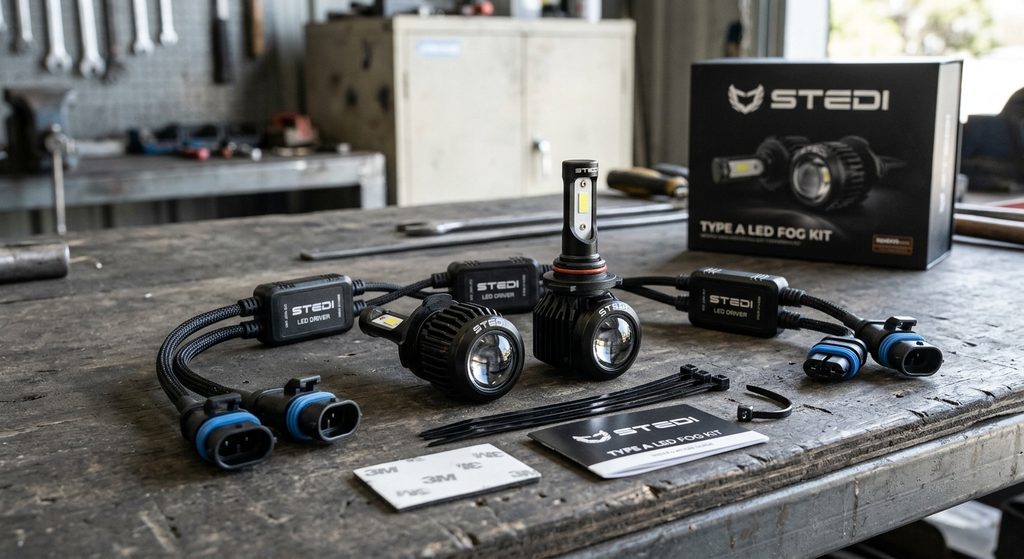
Source: STEDI UK
Davitech Universal 3-Inch Bi-LED 3-Color Projector Fog Light
Best for adjustable lighting colors
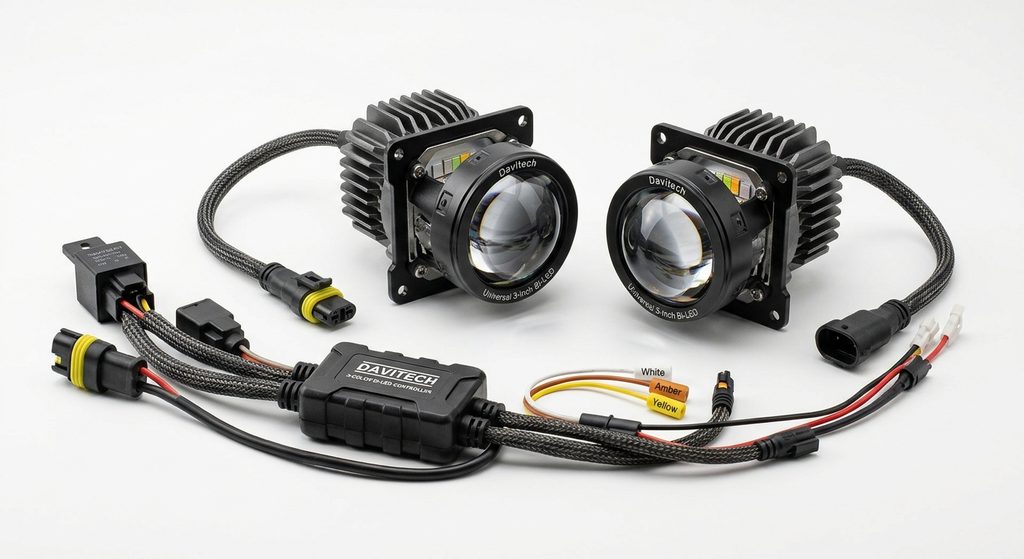
Its three color settings, aluminum construction, and waterproof IP67 housing make it an interesting option for drivers wanting adaptable lighting for different weather conditions.
Related products: 3-inch projector mounting brackets, relay harness, automotive wiring connectors.
Source: Davitech Auto Parts, Spares and Diagnostics
Spec-D Universal Projector Fog Lights with RGB LED Halo Rim
Best for customized styling
This kit combines projector fog lights with RGB halo rings, H7 bulbs, mounting brackets, and a wiring harness for drivers seeking functional lighting with customizable styling.
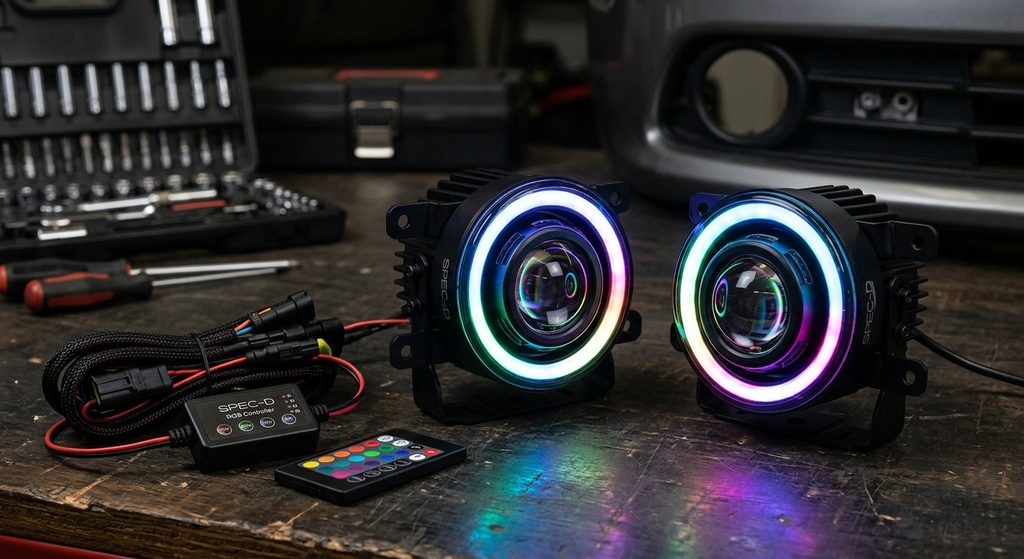
Related products: H7 replacement bulbs, fog light relay kits, automotive switches, mounting hardware.
Source: K2 Industries
Important buying tip: These products are not universal direct-fit replacements for every vehicle. Check the lens diameter, mounting depth, voltage, connector type, bumper clearance, and vehicle-specific compatibility before purchasing. Also confirm that the lighting system meets applicable road-use regulations.
What Is a Projector Lens Fog Light for a Car and How Does It Work?
A projector lens fog light for a car is an automotive lighting system designed to produce a focused, controlled beam that improves visibility during foggy, rainy, snowy, or dusty driving conditions. Unlike traditional reflector fog lights, which use reflective surfaces to distribute light, projector fog lights use a specialized optical lens to direct illumination toward the road.
The projector assembly typically contains several important components:
- LED or HID light source: Produces the light used to illuminate the road.
- Projector lens: Focuses and distributes light into a controlled beam pattern.
- Reflector or optical chamber: Helps collect and direct light toward the lens.
- Cutoff shield: Creates a defined upper beam boundary to reduce unwanted glare.
- Housing: Protects the internal components from moisture, dust, and road debris.
How does the technology work?
When the fog light is switched on, the LED or HID bulb produces light inside the projector assembly. The optical system collects and focuses this light before directing it through the front lens.
The resulting beam is generally wide and positioned relatively low, illuminating the road edges and nearby surfaces. This is particularly helpful because fog consists of tiny water droplets that scatter light back toward the driver.
A properly designed fog light minimizes excessive upward illumination, reducing the amount of light reflected directly into the driver’s eyes.
Modern projector fog lights may also feature Bi-LED technology, allowing one lighting module to provide both low-beam and high-beam functions. Some models offer multiple color temperatures, including white, yellow, and selective yellow.
Ultimately, projector lens fog lights combine optical precision and modern lighting technology to provide better-controlled illumination when driving conditions become challenging.
Key Benefits of Installing Projector Lens Fog Lights in Your Car
Installing projector lens fog lights can improve your vehicle’s lighting performance, especially when driving in challenging weather conditions. Their optical design offers several advantages over conventional fog lights, making them a popular upgrade among drivers looking for better road illumination and a modern appearance.
Here are the main benefits.
Improved Visibility in Foggy Conditions
One of the biggest advantages of projector lens fog lights is their ability to produce a controlled, low-mounted beam. This helps illuminate the road surface, lane markings, and nearby road edges when visibility is reduced.
Yellow projector fog lights can be particularly useful in certain poor-visibility conditions because their lower color temperature may reduce perceived glare for some drivers. However, beam pattern and proper alignment matter more than color alone.
Better Beam Control
Projector lenses concentrate and distribute light more precisely than many traditional reflector designs. A properly engineered projector fog light creates a defined beam pattern that reduces unnecessary upward light and helps minimize glare for approaching motorists.
Modern Appearance
Projector fog lights can give your vehicle a more contemporary appearance. Many aftermarket models feature LED elements, illuminated halos, compact lenses, and stylish housings that complement modern automotive headlight designs.
Energy Efficiency
LED projector fog lights generally consume less electrical power than comparable halogen lighting systems. They also produce less heat at the light source than traditional halogen bulbs, although their LED drivers and internal components still require effective thermal management.
Multiple Lighting Options
Many modern projector fog lights offer different lighting technologies and configurations, including:
- Bi-LED projector fog lights.
- Single-color white LED fog lights.
- Yellow LED fog lights.
- Three-color switchable projector fog lights.
- RGB halo projector fog lights.
These options allow drivers to select lighting systems that suit their vehicles, preferences, and driving environments.
Overall, projector lens fog lights can provide improved beam control, modern styling, and efficient illumination. However, their actual performance depends on optical quality, correct installation, suitable color temperature, and proper alignment.
How to Choose the Best Projector Lens Fog Light for Your Car
Choosing the best projector lens fog light for your car requires more than comparing brightness ratings or selecting an attractive design. You need a lighting system that fits your vehicle, provides a suitable beam pattern, and performs reliably in different driving conditions.
Consider these important factors before purchasing.
Check Vehicle Compatibility
Start by checking whether the projector fog light is compatible with your vehicle’s make, model, and year. Some products are designed for specific factory fog light housings, while others require universal mounting brackets or modifications.
Check the following specifications:
- Projector lens diameter.
- Mounting depth and bracket dimensions.
- Electrical connector type.
- Operating voltage.
- Available bumper clearance.
Choose the Right Lighting Technology
LED projector fog lights are popular because they offer energy efficiency, long operating life, and strong illumination. Bi-LED models provide additional flexibility by combining low-beam and high-beam functions in one projector assembly.
HID projector fog lights are another option, although they may require additional ballasts and more complicated installation.
Consider Color Temperature
Color temperature affects the appearance of the emitted light.
- 3000K yellow: Produces warm yellow illumination and is a popular choice for fog lights.
- 4300K: Provides a warm white appearance.
- 5000K: Produces neutral white illumination.
- 6000K: Creates a cooler, bluish-white appearance.
For frequent foggy or rainy driving, many drivers prefer yellow or warm-white fog lights. However, beam distribution and optical quality are more important than color temperature alone.
Evaluate Brightness and Beam Pattern
Do not select fog lights based exclusively on advertised lumen ratings. Look for independently verified performance information, a wide horizontal beam, and a controlled upper cutoff.
Check Weather Resistance and Build Quality
Choose projector fog lights with sealed housings, quality connectors, corrosion-resistant materials, and suitable water and dust protection.
An IP67 rating, for example, indicates tested protection against dust and temporary immersion under specified laboratory conditions.
Buying tip: Prioritize vehicle compatibility, beam performance, durability, and road-use legality over decorative features or exaggerated brightness claims.
How to Install Projector Lens Fog Lights in a Car
Installing projector lens fog lights in your car can improve its lighting performance and appearance. However, the installation process depends on whether you are replacing existing fog lights or fitting a universal projector fog light kit.
If the installation requires bumper modifications, specialized wiring, or headlight housing adjustments, professional installation is recommended.
Follow these general steps:
Step 1: Gather the Required Tools
Before starting, prepare the necessary tools and installation accessories.
These may include:
- Screwdrivers and socket wrench set.
- Projector fog light kit.
- Vehicle-specific mounting brackets.
- Automotive wiring harness.
- Relay and fuse.
- Electrical connectors and cable ties.
Step 2: Disconnect the Battery
Switch off the ignition and disconnect the negative battery terminal before working on the vehicle’s electrical system. This helps prevent accidental short circuits during installation.
Step 3: Remove the Existing Fog Lights
Access the original fog lights through the bumper or wheel-well area, depending on your vehicle’s design.
Remove the mounting screws and carefully disconnect the electrical connectors. Avoid pulling the wires directly.
Step 4: Install the Projector Fog Lights
Position the new projector lens fog lights in the original mounting locations or compatible aftermarket brackets.
Secure the assemblies using the supplied hardware. Ensure the projector lenses face forward and remain properly positioned.
Step 5: Connect the Wiring
Connect the projector fog lights according to the manufacturer’s wiring diagram.
If the kit requires a separate relay harness, connect it correctly and use the specified fuse rating. Avoid connecting high-current lighting directly to undersized factory wiring.
Step 6: Test and Align the Lights
Reconnect the battery and test the fog lights.
Check that:
- Both lights illuminate consistently.
- The wiring does not become excessively hot.
- There is no flickering or electrical interference.
- The beam is directed low and appropriately toward the road.
Finally, adjust the beam pattern according to the manufacturer’s instructions and applicable vehicle regulations.
Important: Never work beneath an unsupported vehicle or modify safety-critical wiring without the appropriate experience. Incorrect installation can cause electrical damage, water leaks, poor visibility, and dangerous glare.
Common Problems With Projector Lens Fog Lights and How to Fix Them
Although projector lens fog lights are designed to provide reliable illumination, they can develop problems due to poor installation, electrical faults, moisture, or damaged components. Understanding these issues can help you identify the cause and determine whether a simple repair or professional inspection is necessary.
Here are five common problems and their possible solutions.
Projector Fog Lights Are Not Turning On
If your projector fog lights fail to illuminate, the problem may involve a blown fuse, loose electrical connection, damaged wiring, or faulty LED driver.
How to fix it:
- Check the fog light fuse.
- Inspect the wiring connections.
- Test the relay if the system uses one.
- Check the LED driver and power supply.
Replace damaged components with compatible parts rather than bypassing electrical protection.
Fog Lights Are Flickering
Flickering projector fog lights may indicate unstable voltage, loose connectors, poor grounding, or a failing LED driver.
How to fix it: Inspect the ground connection, check the wiring harness, and have the charging system tested if voltage fluctuations are suspected.
Moisture Inside the Projector Lens
Condensation can develop when moisture enters the fog light housing through damaged seals, loose covers, or poorly fitted connectors.
How to fix it: Inspect the housing and seals for damage. Replace defective sealing components and have heavily contaminated or water-damaged assemblies professionally serviced.
Projector Fog Lights Have Weak Illumination
Dim lighting may result from dirty lenses, voltage problems, aging LED components, or incorrectly installed projectors.
How to fix it: Clean the exterior lens using an appropriate automotive cleaner, inspect the electrical supply, and verify beam alignment.
Fog Lights Produce Excessive Glare
Incorrect projector positioning, unsuitable optics, or poor installation can direct excessive light toward approaching drivers.
How to fix it: Recheck the mounting position and adjust the beam according to manufacturer specifications. Replace unsuitable assemblies if proper alignment cannot eliminate the glare.
Maintenance tip: Regularly inspect your projector lens fog lights for moisture, damaged wiring, dirty lenses, and loose mounting hardware. Addressing small problems early can help maintain reliable performance and safer nighttime driving.
Conclusion
A projector lens fog light for a car is a worthwhile lighting upgrade for drivers who want improved beam control, better road illumination, and a modern vehicle appearance. With options ranging from standard LED projector fog lights to advanced Bi-LED and three-color systems, you can choose a solution that matches your vehicle and driving requirements.
However, the best projector fog light is not necessarily the brightest or most expensive. Prioritize vehicle compatibility, quality optics, weather resistance, proper installation, and accurate beam alignment. Regular maintenance also helps ensure consistent lighting performance.
Before purchasing, compare reputable products and verify their road-use compliance. A properly selected and installed projector fog light can make challenging driving conditions easier to manage.
Frequently Asked Questions About Projector Lens Fog Lights for Cars
What is a projector lens fog light for a car?
A projector lens fog light is an automotive lighting unit that uses a specialized optical lens to focus and distribute light into a controlled beam. It helps illuminate the road during fog, rain, dust, and other low-visibility conditions.
Are projector fog lights better than regular fog lights?
Projector fog lights can offer better beam control and a more defined cutoff than some conventional reflector fog lights. However, actual performance depends on optical design, installation quality, and alignment.
Are yellow projector fog lights better for driving in fog?
Yellow fog lights are popular because their warmer color can reduce perceived glare for some drivers. However, yellow light does not eliminate fog reflection. A properly designed beam pattern and suitable alignment are more important.
Can I install projector lens fog lights myself?
Yes, some projector fog light kits support DIY installation, particularly direct-fit replacement models. However, universal kits requiring bumper modifications, specialized wiring, or projector alignment may need professional installation.
How long do LED projector fog lights last?
LED projector fog lights can last thousands of operating hours, depending on component quality, cooling, electrical stability, and environmental conditions. Excessive heat and poor-quality LED drivers can shorten their lifespan.
Do projector fog lights consume more battery power?
Most LED projector fog lights are relatively energy-efficient. Their electrical consumption depends on wattage, operating voltage, and the number of lighting modules installed.
Can projector fog lights be used as headlights?
Some Bi-LED projector fog lights offer low-beam and high-beam functions. However, fog lights are not automatically suitable replacements for dedicated headlights. Use approved headlight systems for their intended purpose.
Are projector lens fog lights waterproof?
Many quality projector fog lights feature weather-resistant housings. Look for an appropriate IP rating, sealed connectors, and properly protected wiring. No rating guarantees protection against every installation or environmental condition.
What is the difference between Bi-LED and regular LED projector fog lights?
Regular LED projector fog lights generally provide one primary beam function. Bi-LED projectors incorporate a mechanism that switches between low-beam and high-beam patterns within the same lighting module.
Do projector fog lights require professional alignment?
Proper alignment is essential to prevent glare and ensure useful road illumination. Professional alignment is recommended, particularly for aftermarket projector systems or installations involving modified mounting positions.
This website is a participant in the Amazon Services LLC Associates Program, an affiliate advertising program designed to provide a means for us to earn fees by linking to Amazon.com and affiliated sites.